Capacity Models
Introduction
The nonlinear behaviour of each building class is characterised by a capacity curve, which defines its global lateral (shear) strength and deformation capacity. Capacity curves are obtained from extensive literature review of regional archetype models, analytical modelling and expert judgement. Capacity curves are commonly expressed in the acceleration-displacement response spectrum (ADRS) domain, i.e., spectral displacement (SD) versus spectral acceleration (SA).
Idealised Capacity Curve Shapes
To reflect differences in structural nonlinear behaviour, three idealised curve shapes are considered:
- Bilinear curves
For buildings that experience negligible elastic stiffness degradation and no significant post-yield loss of lateral strength (e.g., steel and timber frames).
- Trilinear curves
For buildings that exhibit an initial reduction in elastic stiffness due to cracking while maintaining a relatively stable post-yield lateral strength (e.g., reinforced concrete bare frames, dual systems, unreinforced masonry).
- Quadrilinear curves
For structures that undergo substantial reduction in lateral strength at large deformation levels (e.g., reinforced concrete infilled frames).
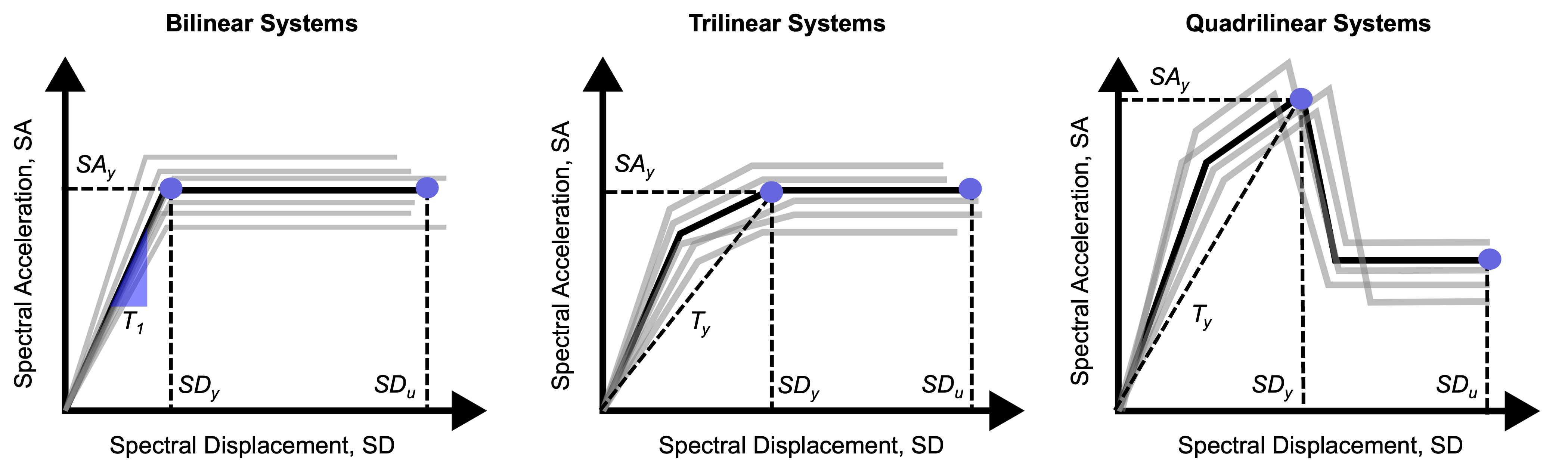
Illustration of capacity model idealizations: bilinear, trilinear, and quadrilinear representations of the pushover curve, highlighting differences in the characterization of yielding, softening, and residual strength plateaus.
The mathematical relationship between SA, SD, and T used to define the capacity curve is:
where \(SD_y\) and \(SA_y\) denote the spectral displacement and acceleration at yielding, \(SD_u\) is the ultimate spectral displacement, \(T_1\) is the first-mode vibration period, and \(T_y\) is the vibration period at yielding.
SDOF to MDOF Calibration
Unlike simplified single-degree-of-freedom (SDOF) oscillators, the vulnerability model adopts stick-and-mass multi-degree-of-freedom (MDOF) systems with masses lumped at floor levels and connected by nonlinear springs defining the storey-shear force versus drift behaviour. These models explicitly capture storey-level demands like peak storey drift (PSD) and peak floor acceleration (PFA).
Conversion from Capacity Curve to Pushover Curve
The capacity curves are converted to pushover curves relating roof displacement (\(u_{roof}\)) to base shear (\(V_{base}\)). The conversion follows structural dynamics principles:
where \(\Gamma_1\) is the first-mode participation factor and \(m_{SDOF}\) is the effective mass of the SDOF oscillator (taken equal to 1.0 ton).
MDOF Storey Mass Calculation
The storey mass of the MDOF model (\(m_{MDOF}\)) is computed as:
where:
\([I]\) is the identity matrix of floor masses with diagonal entries specifying the proportion of \(m_{MDOF}\) assigned to each floor
\(\bar{J}\) is a unity vector of length n (the number of storeys)
\(\phi_1\) is the first-mode shape of the building
\(\phi_1^T\) is its transpose
Storey Force-Drift Relationships
The shear force-drift relationship is proportioned for individual storeys based on \(\phi_1\) following Lu et al. (2014):
where:
\(V_i\) and \(\Delta_i\) are the shear force and drift values associated with storey i
\(\phi_{1,i}\) is the first-mode ordinate at that storey
Mode Shape Assumptions
The first-mode shape \(\phi_1\) is obtained through eigenvalue analysis, considering uniform mass and stiffness across all storeys, except at the roof where mass is decreased by 25%. For buildings exhibiting soft-storey behaviour, the stiffness of the first storey is reduced by 80%.
For bare-frame structures without walls/infills, Eurocode 1-Part 4 recommends:
where i is the storey index.
Capacity Model References
The capacity models are derived from peer-reviewed analytical studies and empirical data. Table 2 below summarises the primary material types and corresponding references used for calibrating the capacity curves.
Primary Material |
Literature References |
|---|---|
Adobe and Rammed Earth |
Tarque et al. (2012); Villar-Vega et al. (2017); Lang et al. (2018); Karanikoloudis & Lourenço (2018); Silveira et al. (2018); Battaglia et al. (2021) |
Unreinforced Masonry |
Barbat et al. (2006); Borzi et al. (2008); Villar-Vega et al. (2017); Lang et al. (2018) |
Reinforced Masonry |
Voon & Ingham (2006); Shedid et al. (2008); Haach et al. (2010); Murcia-Delso & Shing (2012); Lotfy et al. (2022); FEMA (2024a) |
Confined Masonry |
Magenes & Calvi (1992); Nucera et al. (2012); Erkoseoglu et al. (2014); Perez Gavilan et al. (2015); Villar-Vega et al. (2017); Ahmed et al. (2018) |
Reinforced Concrete |
Crowley et al. (2008); Bal et al. (2010); Ricci et al. (2011); Tischer et al. (2012); Villar-Vega et al. (2017); Lang et al. (2018); Tarquini et al. (2019); Parra et al. (2019); Ugalde et al. (2019); Aljawhari et al. (2020); Suzuki & Iervolino (2020); Ugalde & Lopez-Garcia (2020); Farsangi et al. (2021); Gondaliya et al. (2023); FEMA (2024b); Nafeh & O’Reilly (2024) |
Steel Structures |
Sabelli et al. (2003); McCormick et al. (2007); Tasnimi & Mohebkhah (2011); Ramirez et al. (2012); Radnić et al. (2013); Markulak et al. (2013); Abou-Elfath et al. (2017); Eladly (2017); Del Carpio R. et al. (2019); Jouneghani & Haghollahi (2020); FEMA (2024a) |
Timber Structures |
Goda & Atkinson (2011); Loss et al. (2013); Villar-Vega et al. (2017); Lang et al. (2018); FEMA (2024a) |
Interactive Viewer
Use the interactive viewer below to explore capacity curves for different building classes.
References
The capacity models are derived from the following peer-reviewed literature, organised by primary construction material:
Adobe and Rammed Earth
Tarque et al. (2012); Villar-Vega et al. (2017); Lang et al. (2018); Karanikoloudis & Lourenço (2018); Silveira et al. (2018); Battaglia et al. (2021)
Unreinforced Masonry
Barbat et al. (2006); Borzi et al. (2008); Villar-Vega et al. (2017); Lang et al. (2018)
Reinforced Masonry
Voon & Ingham (2006); Shedid et al. (2008); Haach et al. (2010); Murcia-Delso & Shing (2012); Lotfy et al. (2022); FEMA (2024a)
Confined Masonry
Magenes & Calvi (1992); Nucera et al. (2012); Erkoseoglu et al. (2014); Perez Gavilan et al. (2015); Villar-Vega et al. (2017); Ahmed et al. (2018)
Reinforced Concrete
Crowley et al. (2008); Bal et al. (2010); Ricci et al. (2011); Tischer et al. (2012); Villar-Vega et al. (2017); Lang et al. (2018); Tarquini et al. (2019); Parra et al. (2019); Ugalde et al. (2019); Aljawhari et al. (2020); Suzuki & Iervolino (2020); Ugalde & Lopez-Garcia (2020); Farsangi et al. (2021); Gondaliya et al. (2023); FEMA (2024b); Nafeh & O’Reilly (2024)
Steel Structures
Sabelli et al. (2003); McCormick et al. (2007); Tasnimi & Mohebkhah (2011); Ramirez et al. (2012); Radnić et al. (2013); Markulak et al. (2013); Abou-Elfath et al. (2017); Eladly (2017); Del Carpio R. et al. (2019); Jouneghani & Haghollahi (2020); FEMA (2024a)
Timber Structures
Goda & Atkinson (2011); Loss et al. (2013); Villar-Vega et al. (2017); Lang et al. (2018); FEMA (2024a)
Full Citations
Abou-Elfath H., Ramadan M., Alkanai F.O. (2017). Upgrading the seismic capacity of existing RC buildings using buckling restrained braces. Alexandria Engineering Journal, 56(2), 251-262.
Ahmed S., Shahzada K., Khan S.W. (2018). Seismic vulnerability assessment of confined masonry structures by macro-modeling approach. Structures, 14, 282-293.
Aljawhari K., Gentile R., Galasso C. (2020). A fragility-based framework to assess the seismic risk of an RC building portfolio. Earthquake Spectra, 36(4), 1797-1822.
Bal I.E., Crowley H., Pinho R., Gülay F.G. (2010). Structural characteristics of Turkish RC building stock in Northern Marmara region for loss assessment applications. ISET Journal of Earthquake Technology, 47(2-4), 35-69.
Barbat A.H., Pujades L.G., Lantada N. (2006). Performance of buildings under earthquakes in Barcelona, Spain. Computer-Aided Civil and Infrastructure Engineering, 21(8), 573-593.
Battaglia L., Ferreira T.M., Lourenço P.B. (2021). Seismic fragility assessment of masonry building aggregates: A case study in the old city centre of Seixal, Portugal. Earthquake Engineering & Structural Dynamics, 50(5), 1358-1377.
Borzi B., Pinho R., Crowley H. (2008). Simplified pushover-based vulnerability analysis for large-scale assessment of RC buildings. Engineering Structures, 30(3), 804-820.
Crowley H., Pinho R., Bommer J.J., Bird J.F. (2008). Development of a displacement-based method for earthquake loss assessment. IUSS Press, Pavia.
Del Carpio R.M., Mosqueda G., Lignos D.G. (2019). Experimental investigation of steel building gravity framing systems under strong earthquake shaking. Soil Dynamics and Earthquake Engineering, 116, 230-241.
Eladly M.M. (2017). Cyclic testing of steel frames with buckling-restrained braces. Journal of Constructional Steel Research, 138, 325-338.
Erkoseoglu G., Altunel E., Beyhan G. (2014). Seismic fragility assessment of confined masonry construction. Bulletin of Earthquake Engineering, 12(6), 2831-2855.
Farsangi E.N., Tasnimi A.A., Yang T.Y., Takewaki I. (2021). Seismic performance of RC buildings designed based on INBC. Engineering Structures, 232, 111806.
FEMA (2024a). FEMA P-58: Seismic Performance Assessment of Buildings. Federal Emergency Management Agency.
FEMA (2024b). Hazus Earthquake Model Technical Manual. Federal Emergency Management Agency.
Goda K., Atkinson G.M. (2011). Seismic performance of wood-frame houses in south-western British Columbia. Earthquake Engineering & Structural Dynamics, 40(8), 903-924.
Gondaliya K., Murty C.V.R. (2023). Seismic fragility of reinforced concrete buildings in India. Structures, 48, 1326-1340.
Haach V.G., Vasconcelos G., Lourenço P.B. (2010). Experimental analysis of reinforced concrete block masonry walls subjected to in-plane cyclic loading. Journal of Structural Engineering, 136(4), 452-462.
Jouneghani H.G., Haghollahi A. (2020). Assessing the seismic behavior of steel moment frames equipped by elliptical-bracing. Journal of Building Engineering, 31, 101333.
Karanikoloudis G., Lourenço P.B. (2018). Structural assessment and seismic vulnerability of earthen historic structures. Engineering Structures, 172, 295-311.
Lang D.H., Kumar A., Sulaymanov S., Meslem A. (2018). Building typologies and fragility functions for northern Central Asia. Natural Hazards and Earth System Sciences, 18(11), 2959-2975.
Loss C., Tannert T., Tesfamariam S. (2013). Modern timber buildings: Challenges and opportunities in seismic design. Building and Environment, 62, 103-112.
Lotfy I., El-Shazly A., Husain M. (2022). Seismic evaluation of reinforced masonry shear walls. Structures, 36, 833-847.
Magenes G., Calvi G.M. (1992). Cyclic behavior of brick masonry walls. In 10th World Conference on Earthquake Engineering, Madrid, Spain.
Markulak D., Radić I., Sigmund V. (2013). Cyclic testing of single bay steel frames with various types of masonry infill. Engineering Structures, 51, 267-277.
McCormick J., Aburano H., Ikenaga M., Nakashima M. (2007). Permissible residual deformation levels for building structures considering both safety and human elements. In 14th World Conference on Earthquake Engineering.
Murcia-Delso J., Shing P.B. (2012). Fragility analysis of reinforced masonry shear walls. Earthquake Spectra, 28(4), 1523-1547.
Nafeh A.M.B., O’Reilly G.J. (2024). Simplified pushover-based seismic risk assessment methodology for existing infilled RC frame buildings. Bulletin of Earthquake Engineering, 22(1), 251-283.
Nucera F., Santini A., Tripodi E., Saetta A. (2012). Influence of soil-structure interaction on the seismic response of a confined masonry building. Engineering Structures, 39, 101-115.
Parra P.F., Arteta C.A., Moehle J.P. (2019). Seismic fragility functions for thin reinforced concrete walls. Engineering Structures, 184, 147-160.
Perez Gavilan J.J., Flores L.E., Alcocer S.M. (2015). An experimental study of confined masonry walls with varying aspect ratios. Earthquake Spectra, 31(2), 945-968.
Radnić J., Grgić N., Matešan D., Baloević G. (2013). Shaking table testing of reinforced concrete frames with masonry infill. Gradevinar, 65(7), 605-620.
Ramirez C.M., Lignos D.G., Miranda E., Kolwicz D. (2012). Fragility functions for pre-Northridge welded steel moment-resisting beam-to-column connections. Engineering Structures, 45, 574-584.
Ricci P., De Luca F., Verderame G.M. (2011). 6th April 2009 L’Aquila earthquake, Italy: reinforced concrete building performance. Bulletin of Earthquake Engineering, 9(1), 285-305.
Sabelli R., Mahin S., Chang C. (2003). Seismic demands on steel braced frame buildings with buckling-restrained braces. Engineering Structures, 25(5), 655-666.
Shedid M.T., Drysdale R.G., El-Dakhakhni W.W. (2008). Behavior of partially grouted reinforced masonry shear walls under reversed cyclic loading. Journal of Structural Engineering, 134(11), 1754-1764.
Silveira D., Varum H., Costa A. (2018). Seismic behavior of rammed earth constructions. Construction and Building Materials, 175, 293-306.
Suzuki A., Iervolino I. (2020). Hazard-consistent intensity measure conversion for fragility and risk analysis. Earthquake Engineering & Structural Dynamics, 49(10), 952-972.
Tarquini D., Dal Lago B., Peloso S. (2019). Large-scale testing of precast concrete structures. Bulletin of Earthquake Engineering, 17(4), 2049-2076.
Tarque N., Crowley H., Pinho R., Varum H. (2012). Displacement-based fragility curves for seismic assessment of adobe buildings in Cusco, Peru. Earthquake Spectra, 28(2), 759-794.
Tasnimi A.A., Mohebkhah A. (2011). Investigation on the behavior of brick-infilled steel frames with openings. Engineering Structures, 33(3), 968-980.
Tischer H., Mitchell D., McClure G. (2012). Comparison of structural response of an existing reinforced concrete building frame to near-field and far-field earthquakes. Canadian Journal of Civil Engineering, 39(12), 1291-1306.
Ugalde D., Lopez-Garcia D. (2020). Analysis of the seismic capacity of Chilean residential RC walls. Bulletin of Earthquake Engineering, 18(3), 1189-1209.
Ugalde D., Parra P.F., Lopez-Garcia D. (2019). Assessment of the seismic capacity of tall wall buildings using nonlinear finite element modeling. Bulletin of Earthquake Engineering, 17(11), 6183-6203.
Villar-Vega M., Silva V., Crowley H., et al. (2017). Development of a fragility model for the residential building stock in South America. Earthquake Spectra, 33(2), 581-604.
Voon K.C., Ingham J.M. (2006). Experimental in-plane shear strength investigation of reinforced concrete masonry walls. Journal of Structural Engineering, 132(3), 400-408.